



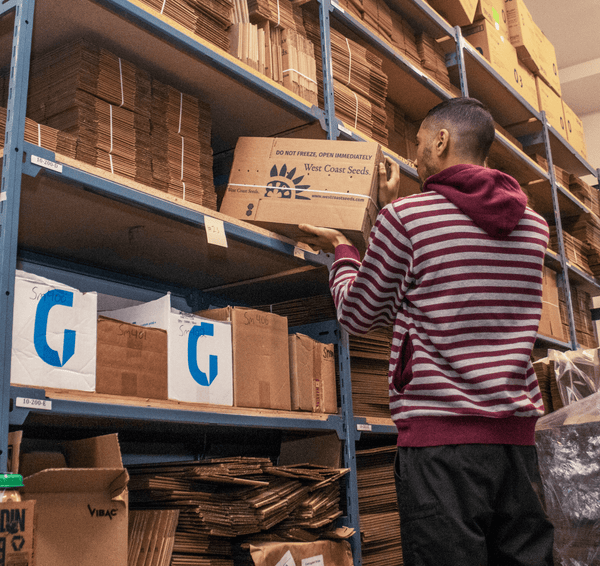
West Coast Seeds ships anywhere in North America. However, we are not able to ship garlic, potatoes, asparagus crowns, bulbs, onion sets, Mason bee cocoons, or nematodes outside of Canada.
Exposure Full-sun
Matures in 75-110 days
Season Hot season
Seed type OP ?
Average Seeds Per Gram 440 ?
West Coast Seeds ships anywhere in North America. However, we are not able to ship garlic, potatoes, asparagus crowns, bulbs, onion sets, Mason bee cocoons, or nematodes outside of Canada.
For every order online, we donate a pack of seeds to gardens and communities worldwide through our Seeds of Growth program, supporting sustainable growth and local food systems.
The raw seeds of Golden Sesame resemble the toasted seeds of white sesame. Once they are fully dry they turn a nice golden brown colour. The flavour is somewhat milder than the Black Sesame kind, but still tasty and appealing. Use this variety to grind into tahini, or toast the seeds and sprinkle them over salads or sushi. The subtle crunch and flavour really elevates nearly any dish. Remember that the plants are heat and drought loving. Any steps that will add heat will improve productivity. Try growing them in a raised bed with no irrigation. In our field trials, black plastic mulch seemed to produce a good response. This plant is excellent for xeriscaping and for attracting pollinators.
We'll notify you when this product is back in stock.
Latin
Latin
Sesamum indicum
Family: Pedaliaceae
Difficulty
Difficulty
Somewhat challenging
Season & Zone
Season & Zone
Season: Hot season
Exposure: Full sun
Timing
Timing
Sow seeds indoors 4-6 weeks before the last average frost date. Transplant under cover a similar period after the last frost date. Remove the cover in late spring, once the night time temperatures are consistently above 10°C (50°F).
Starting
Starting
Lightly cover the seeds with sterilized, soil-less starter mix, and keep just moist until germination. Don’t keep the seeds in a highly damp environment, and be sure not to over-water the seedlings. Once they sprout, reduce watering to once a week until transplant time. Optimal soil temperature for germination: 21°C (70°F).
Days to Maturity
Days to Maturity: From transplant date.
Growing
Growing
If steps are taken to increase warmth in and around the plants, they will be more productive. Try transplanting into a raised bed, or into the ground using black plastic mulch over the soil. Do not fertilize sesame plants, and avoid drip irrigation, as they really do like it dry. Plant fairly densely at 15cm (6″) spacing, in rows 60-45cm (24-36″) wide. Sesame is indeterminate, so it will continue to bloom and set seed capsules until the end of summer. Expect flowering to peak in mid- to late summer.
The tubular flowers of the sesame plant are highly attractive to honeybees, and are said to produce some of the highest grade of honey. The plants are relatively self-fruitful, so when the flowers open, the seeds are already fertilized. The seeds are produced in pods (seed capsules) that appear along the stem, appearing from the bottom upward.
Harvest
Harvest
Around the end of summer, some of the pods near the bottom of the stem (the first flowers that opened), may begin to show signs of ripeness. When ripe, the pods begin to split from the blossom end. Don’t worry if this doesn’t happen in the field. Before cold, wet weather arrives, cut the stems at the base and gather them to dry some place that is flat — hanging them will cause the seeds to just fall out as the pods dry. As the plants dry, the foliage will darken and more pods will open from the base of the stem upwards. Once most of the pods have opened, bash them against the sides of a bucket to collect the dry seeds. The seeds are edible at this stage, and resist spoilage better than most nuts. They can also be toasted, pressed for oil, or ground into the paste known as tahini.
Sesame plants each produce quite a lot of seeds, but the seeds have little mass. From a 10 foot long, 2½ foot wide row, expect to harvest approximately 425g (just under one pound) of seeds.
West Coast Seeds is a family-owned company that embraces an organic lifestyle. A group of imagination catalysts and passionate educators, dedicated to producing products and services that better the environment. As part of our mission to repair the earth, we aim to inspire and empower people to take responsibility for the state of the planet. For us, organic is about much more than saying no to chemicals, it is about saying yes to building a healthy soil for the future.
For over 35 years, we have upheld our strong reputation as a leading seed supplier, seeking out the highest quality untreated seeds for organic growing and putting them through rigorous independent testing. We built our company on the exchange of generational wisdom in a masterclass community of newbies and masters alike. Our world may have changed, but our commitment to our people, our customers, and our planet has not.
We’re a values-based business that has blossomed into a lifestyle ethos, with products that support seeders, feeders, keepers, and the tiniest of creepers. Our mission? To mobilize the next generation of gardeners with products that nourish soil and grow vigorous, sustainable gardens. We believe all plants should be grown without the use of chemicals, and that the seeds we supply are an important component of regenerative gardening.
We don’t just offer seeds, we offer experience, insight, and understanding. From timeless garden wisdom to new tech know-how, this is learning on the job: knowledge gleaned not from the pages of a book but from burying our fingers in the soil. We test, experiment, observe and adapt, never happier than when we get to share what we’ve learned with others.
Gardens don’t just grow seeds. They grow minds and imaginations, people and communities. Our vision encompasses both the micro and the macro. We eat locally, protect pollinators, teach people to grow from seed, and support regional biodiversity. We think big but act small and deliver unexpected impact — always with community and purpose.
At West Coast Seeds we believe in the power of small and that little can be large. Like the tiniest seed germinates to evoke incremental change with massive potential, so to can our community of gardeners and growers together. Gardeners are the earth’s stewards, planting seeds of creative declaration. The soil provides the canvas, we provide the seeds.
Sow seeds indoors 4-6 weeks before the last average frost date. Transplant under cover a similar period after the last frost date. Remove the cover in late spring, once the night time temperatures are consistently above 10°C (50°F).
Lightly cover the seeds with sterilized, soil-less starter mix, and keep just moist until germination. Don’t keep the seeds in a highly damp environment, and be sure not to over-water the seedlings. Once they sprout, reduce watering to once a week until transplant time. Optimal soil temperature for germination: 21°C (70°F).
If steps are taken to increase warmth in and around the plants, they will be more productive. Try transplanting into a raised bed, or into the ground using black plastic mulch over the soil. Do not fertilize sesame plants, and avoid drip irrigation, as they really do like it dry. Plant fairly densely at 15cm (6″) spacing, in rows 60-45cm (24-36″) wide. Sesame is indeterminate, so it will continue to bloom and set seed capsules until the end of summer. Expect flowering to peak in mid- to late summer.
The tubular flowers of the sesame plant are highly attractive to honeybees, and are said to produce some of the highest grade of honey. The plants are relatively self-fruitful, so when the flowers open, the seeds are already fertilized. The seeds are produced in pods (seed capsules) that appear along the stem, appearing from the bottom upward.
Days to Maturity: From transplant date.
From a 10 foot long, 2½ foot wide row, expect to harvest approximately 425g (just under one pound) of seeds.
Around the end of summer, some of the pods near the bottom of the stem (the first flowers that opened), may begin to show signs of ripeness. When ripe, the pods begin to split from the blossom end. Don’t worry if this doesn’t happen in the field. Before cold, wet weather arrives, cut the stems at the base and gather them to dry some place that is flat — hanging them will cause the seeds to just fall out as the pods dry. As the plants dry, the foliage will darken and more pods will open from the base of the stem upwards. Once most of the pods have opened, bash them against the sides of a bucket to collect the dry seeds. The seeds are edible at this stage, and resist spoilage better than most nuts. They can also be toasted, pressed for oil, or ground into the paste known as tahini.
Sesame plants each produce quite a lot of seeds, but the seeds have little mass. From a 10 foot long, 2½ foot wide row, expect to harvest approximately 425g (just under one pound) of seeds.