





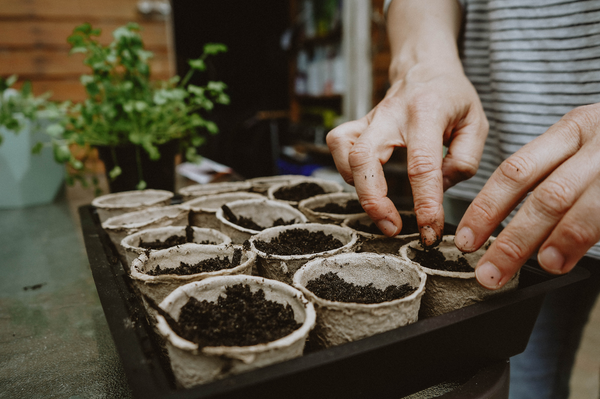




Organic gardeners share one challenge that has many faces – how to protect seedlings along to the point when they are strong enough to defend themselves. Because seedlings are so tender and tasty, and low to the ground, they are easy pickings for a host of animals, from the very tiny to the enormous. Everything from wireworms and millipedes up to raccoons and deer are perfectly happy to chomp on veggies, sometimes eradicating a whole bed of newly emerged plants.
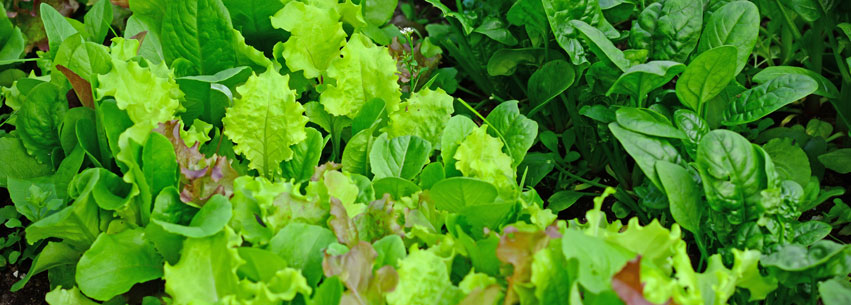
Every spring we receive a host of emails asking, “How to I protect my seedlings from (insert pest here)?” The best advice we can offer is to correctly identify the pest in question, and try to understand its behaviour and needs. Slugs and rabbits have very little in common other than a shared taste for vegetables, so the strategies to control them are just as different. Let's start with the most common garden pests, and attempt offer some sound advice.
1. Slugs & Snails
During the day time, these gastropods need to take shelter from the sun. Snails can withdraw into the climate control of their shells, but slugs have to seek deep shade or total shade. This is their greatest weakness, and the basis of the best organic strategies to controlling them. Water first thing in the morning, after they have crept into their daytime hiding spots. Watering in the evening creates the ideal environment for both slugs and snails, and provides an invitation to come and feast. By watering in the morning, the garden is relatively dry by evening, especially in summer. Also, be sure to remove ALL the possible hiding spots from the garden that aren’t strictly necessary – unused pots, bricks, boards, plastic mulch, anything they can hide under, particularly where moisture might accumulate.
Slugs can be trapped by leaving out little tubs of beer, as they are attracted to the smell of the yeast and will drown in it. Even simpler than that method is to intentionally leave one obvious hiding spot out overnight, encourage them to gather there, and then walk them off the premises the next morning. Plywood works well for this kind of trap. Simply leave a piece between your beds and collect the slugs the next morning.
There is much wisdom on various materials slugs do not like to cross. The idea is to make a barrier around the garden, and the slugs won’t venture over the material laid down. We have experimented with crushed eggshells, and were not impressed with the results. Human hair, collected from a barbershop, is another option that, in our experience, doesn’t work well enough and looks very strange.
2. Woodlice
These are the little grey-coloured, armour plated chaps that seem to be available in inexhaustible supply in coastal gardens. They are crustaceans of the suborder Oniscidea, which represents around 3,000 species. Some of them, in the appropriately named genus Armadillidium, can roll into a perfect ball as a means of defence. These are commonly called pill bugs, as opposed to the ones that can’t roll up, which are known as sow bugs. Because they are crustaceans, they need water to live. Like slugs, the damper the garden is, the more abundantly they will come. So water in the morning, and remove hiding spots.
Woodlice are a good example of why the “good bug/bad bug” approach doesn’t work well. While they may feed on tender seedlings (particularly ones already damaged by slugs or snails), they play a key role in breaking organic matter down in soil. The kinds of food woodlice can feed on are inedible to many other garden organisms, but what they leave behind can be then broken down further by bacteria and fungi. They are key to healthy composting systems, so eradicating them is a poor choice. Just try to keep the garden as dry as possible.
Okay – so the same strategies can be applied to slugs, snails, and woodlice. If they just can’t be controlled in the garden, it might be time to contemplate using only transplanted vegetables, and giving up on direct sowing seeds. Established plants have an easier time coping against pests than seedlings do.
3. Specific insects
We have evolved past the old-school dinosaur way of thinking that says, “Just spray the whole area with malathion or diazanon, and kill all the insects at once.” No. That’s not going to work. What organic gardeners want is MORE insects, not fewer, and we want them to be present in sufficient numbers that they will come to a harmonious balance in our gardens and in our soil. So when you find damage to your crops or ornamental plants, it’s essential to correctly identify the culprit.
If you can’t see and identify the culprit insect, try to identify the damage it’s causing to the crop. Here are some typical examples.
Small, pin-like holes appear in the middle of leaves in mustard, lettuce, and spinach – almost always flea beetles.
Sudden, dramatic damage to leaves of Brassicas (cabbage, cauliflower, broccoli, kale, kohlrabi) – almost always cabbage moth (true name Small White butterfly).
Orange-coloured “tracks” or erratic, slightly indented lines around carrot roots – almost always carrot rust fly larvae.
Small holes directly into hard root crops like carrots, beets, or potato – almost always wireworm.
Entomologists categorize groups of like insects into “orders.” The order Lepidoptera, for example, includes all moths and butterflies. Beetles are all within the order Coleoptera; flies, Diptera; bees, wasps, and ants, Hymenoptera; and so on. Not only do these groups show how insects are related, but they offer helpful guidance to gardeners needing pest control. For instance, the bacteria known as Bacillus thuringiensis (BT) can be used as a biological control for all Lepidopterans (moths & butterflies), but it will not harm any other types of insects. Predatory nematodes can be applied as a biological control for soil-dwelling beetle larvae, but they won’t harm, say, earthworms, or other beneficial soil creatures.
For information on how to deal with specific insects on specific plant groups, please refer to our website articles here. W'd like to stress the poinit that the organic approach hinges on correctly identifying the pest in question, and then taking action appropriate to the one insect.
4. Mammals
The tops of radishes have all been nibbled above the soil line? A whole bed of seedlings have been “topped” overnight? Curious poops are appearing, buried or otherwise? Correctly identifying the culprit mammal in question will also help provide guidance to its control, but producing a physical barrier between the mammal and the crop is the most obvious first step. For rabbits and rats, chicken wire can be effective enough that they will simply give up and go on to greener pastures. Cats need to have a more obvious barrier put between them and your nice new raised beds. Try building a lightweight frame roughly the same size as your raised bed. PVC pipe works really well for this. Then stretch any kind of durable small-holed netting over the frame, and leave this over your beds during the entire time your seedlings are coming up. Once the planted bed is full of plants, it will not be attractive as a litter box, and the frame can be put away for a year.

If you want to have a rabbit and deer-free area in which to grow vegetables, herbs, and flowers, you simply have to build a fence. It’s got to be high enough that deer can’t jump over it, and constructed so that rabbits can’t wiggle through at the bottom. Rabbit and deer repellents work to some extent. They are typically made out of dried deer blood, and need to be applied regularly enough that the fresh scent will alarm deer and make them take flight. But in a dry summer, when grazing is bad, deer will just take food wherever they can get it, so this is not 100% reliable.
All mammals have sensitive mucous membranes. A mix of soapy water with a small amount of cayenne pepper can be sprayed on areas where physical barriers are not possible, or when the pest in question is too small (mice, voles) to control with a conventional fence. Cayenne works because it causes temporary pain to the mammal in question, but we have mixed feelings about it. We prefer physical barriers, and would only use cayenne as a last resort.
5. Animals that are not the problem
We get the odd phone call or email from customers wanting to rid themselves of perceived pests that aren’t really pests. It's often best to simply leave them alone, or learn to live with them.
Moles are carnivores that tunnel through the soil in search of earthworms and grubs. The only damage they may do to crops is inadvertently displace roots as they dig new tunnels. Unless there is a physical barrier to prevent them from leaving the garden, they will eventually move along. So just ignore them.
Ants are not pests. It's true that carpenter ants can cause serious problems if they nest in a house, and ants can be a nuisance indoors, but in the garden, they are like their Hymenopteran cousins the wasps. They remove other insects from the garden, and in most cases are entirely beneficial. There is a common misdiagnosis that ants carry aphids up into fruit trees in order to “farm” them by gathering the aphids’ honeydew. While ants certainly do harvest honeydew from aphids, they do not carry the aphids into the tree. If you “have seen them doing this,” please have a closer look. The ants are on the tree because there are aphids present. The aphids are on the tree because, nine times out of ten, the tree is under some sort of stress. Instead of focusing on the ants, focus on the health of the tree – apply lime and adequate water, and apply fertilizer. Maybe cut back grasses from the base of the tree. Deal with the aphids with blasts of water from a hose, or apply Safer’s soap. Don’t bother with tanglefoot or vaseline. These treatments will only make your tree sticky, and are not effective against aphids, or beneficial ants.
Spittlebugs are also not pests. These are the tiny yellow or green guys who show up on the stems of flowering plants in late spring – they’re quite noticeable on lavender stems. While it’s true that they suck plant juices in the same way that aphids do, they're only going to be present for a couple of weeks. That’s because they are the nymph stage of the adult insect known as the Froghopper (order Hemiptera). Froghoppers and their close cousins leafhoppers, are the very small, hard-shelled creatures that suddenly land on your shirt when you’re out in the garden. As soon as they are touched, they spring away with incredible force, and you don’t see them again. If nesting spittlebugs are present, just try to look the other way and carry on weeding.
In closing, we feel that it's most helpful to take a non-adversarial approach to gardening. By cultivating healthy soil and ecologically diverse gardens, we can produce healthier plants with better resistance to pests and disease. We can lure predatory wasps, ladybird beetles, and other beneficial insects, by inviting them to the garden with the appropriate plant choices. Grow dill! Plant Alyssum. Let last year’s parsley flower and go to seed. Keep the growing area tidy, but diverse. Our friend and colleague Brian Campbell recommends dedicating an area of the garden where you never set foot. Leave it aside to act as an undisturbed natural environment where nature can truly take its course.
For further reading, we recommend this book: The Organic Gardener’s Handbook of Natural Pest and Disease Control by Bradley, Ellis, and Martin is an excellent reference style book for identifying and controlling insect pests, as well as avoiding plant diseases.