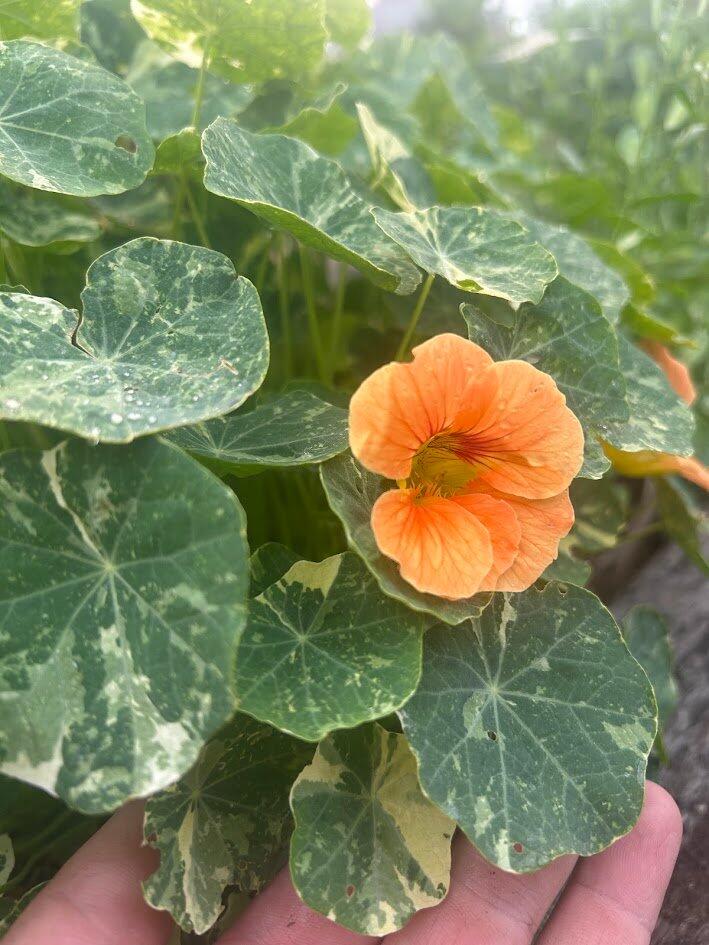




Edible flowers can be used to add a splash of colour to all kinds of foods, from salads to desserts to fancy cocktails. A single borage petal, carefully placed, can really enhance a slice of cake or an amuse bouche....
Continue ReadingAs the growing season shifts to winter mode, our attention turns to protecting food plants and flower beds and baskets for as long as possible. Watch for the first signs frost, which sneaks in on a clear windless autumn night....
Continue ReadingHedgerows provide important cover for mammals, from voles to coyotes, and create a natural corridor to cross the property in relative safety. The shrubs provide excellent nesting sites for songbirds, and the tall trees (eventually) provide much needed nesting spots for raptors. We are so pleased to add this feature to our organic field.
Continue ReadingWinter is a gift: itβs natureβs down time, a time when many plants go dormant and many animals have a winterβs rest. However, for those animals that are still active, winter can be a challenge. Itβs hardΒ for small animals to...
Continue ReadingSquirrel Tail Grass begins the season as a fairly unremarkable grassy plant, but once the warm weather and long days of summer arrive, it sends up remarkable, silky, silvery grey panicles on 60cm (24") stems. These bend with the wind and retain their ornamental value until frost.
Continue ReadingMonkshood is a very traditional perennial for the cottage garden. The plant is so well known for its toxicity that it plays a role in ancient Greek mythology, and folklore from Europe to India. So please don't eat it.
Continue ReadingDifferent bees and pollinators benefit from specific types of flowers. Whether a flower is deep or shallow, red or yellow, generous with nectar or stingy... These all impact the attractiveness to different pollinators. We have collected some of the Best...
Continue ReadingUnderstanding the relationships between specific types of flowers and specific pollinators helps to explain why biodiversity is so important. The greater variety of flowers (including vegetables and herbs) in the garden, the wider range of pollinators can be supported.
Continue ReadingFenugreek is an annual herb that is native to the Mediterranean region. Seeds found in ruins in modern day Iraq were carbon dated to 4000 BCE. It grows best in fertile soil in full sun. Learn more about how to...
Continue ReadingItβs a beautiful summer day. Since sowing your tomato seeds in Spring, youβve been nurturing your container garden, preparing for harvest. There is nothing like a juicy, summer-ripened tomato fresh from the garden. Finally, itβs time. You will taste the...
Continue ReadingPrior to the potatoβs arrival from the New World, turnip was the root-crop of choice for cool, wet soils, so many northern European cultures have significant relationships with this vegetable. It says a lot about turnips.
Continue ReadingThese two culinary herbs are very closely related, with flavours that are almost indistinguishable. They represent two of about 20 species of Oregano, all members of the mint family, Lamiaceae. They offer a good opportunity to learn more about marjoram and oregano.
Continue ReadingAll butterflies (including moths), as well as a wide range of bees, flies, beetles, and even hummingbirds, will feed on the nectar-heavy flowers of all milkweed varieties. The Monarch, however, seeks milkweed out on which to lay her eggs. Monarch caterpillars require milkweed to feed on prior to pupating, and they tend not to thrive when presented with alternative food sources. Planting milkweed is thought to be the number one step North American gardeners can do to help the endangered Monarch.
Continue ReadingWhat the heck is xeriscaping? Simply put, xeriscaping is a system of landscaping with water conservation as the priority. In areas that receive little rainfall in the summer, some thoughtful xeriscaping will allow flowering plants to thrive, adding visual appeal...
Continue ReadingMost of the vegetables we eat on a regular basis are cultivated adaptations from some older source. A good example is broccoli, which is the very same species of plant as cabbage, cauliflower, Brussels sprouts, kale, and kohlrabi. All of...
Continue ReadingAsparagus crowns are live goods that have been freshly harvested from the soil. Like seed potatoes and hops rhizomes, they have only recently been dug from the soil, and are in a state of dormancy. This dormancy is broken in response to temperature, day length, and available moisture.
Continue ReadingEggplant seeds are relatively slow to germinate, and will probably take 10 days or longer. Soil heated from beneath is likely to speed germination and help young plants develop. Aim for around 27Β°C (just over 80Β°F). Sow indoors as long as 12 weeks before the last frost to give them a really good head start.
Continue ReadingMany varieties of maize are grown for dried, fully mature seed, which is eaten as a grain, but sweet corn is picked before the seeds mature fully, before its sugars convert back into starch. This is why fresh corn must be eaten fairly quickly after harvest, before it degrades and becomes starchy.
Continue ReadingThe precursor to the modern Brussels sprout were likely grown in ancient Rome, and todayβs vegetable was perfected and popularized as early as the 13thΒ century, in Belgium, which explains their common name. By the mid-16thΒ century, they were being cultivated in the Netherlands and other parts of Europe.
Continue ReadingBuilding raised beds for your vegetable (or herb, or flower) garden requires an investment of work plus the cost of materials, but they will reward you in the coming years in a number of ways. Raised beds are usually built out of lumber, but a wide variety of other materials can be used, from bricks and stones to recycled plastic sheets. The premise is simply to contain the soil within some sort of frame that holds the soil above ground level.
Continue ReadingBroccoli has quite a few close relatives and variations, and these are designated in botany by the use of βcultivar groups.β Kale and collards, Chinese broccoli, cauliflower, cabbage, Brussels sprouts, and kohlrabi all share the Latin nameΒ B. oleracea, but belong to different groups within that single species. Broccoli itself has several varieties: The most common youβre likely to see in grocery stores is called Calabrese in the UK, and just βbroccoliβ here in North America.
Continue ReadingThe wildflower seeds in our Knee High Meadow Blend produce a waist-high field of brilliantly coloured flowers that bloom over a very long period from spring to fall. This blend is best for areas that will be protected from foot...
Continue ReadingMany people in North America think of kohlrabi as being a distinctly European vegetable, but it is actually a staple ingredient in many international cuisines. It is has been a popular crop, for instance, in Northern India and Kashmir since the 1600s.
Continue ReadingArchaeological evidence suggestsΒ peas were grown as food crops in Neolithic Turkey, Syria, and Jordan, and in the Nile valley in Egypt as early as 4500 BC. Dried peas remained an important foodstuff in Europe into the Middle Ages, but some time in the late 1600s eating green peas (as we do today) became a culinary fad in France and England.
Continue Reading